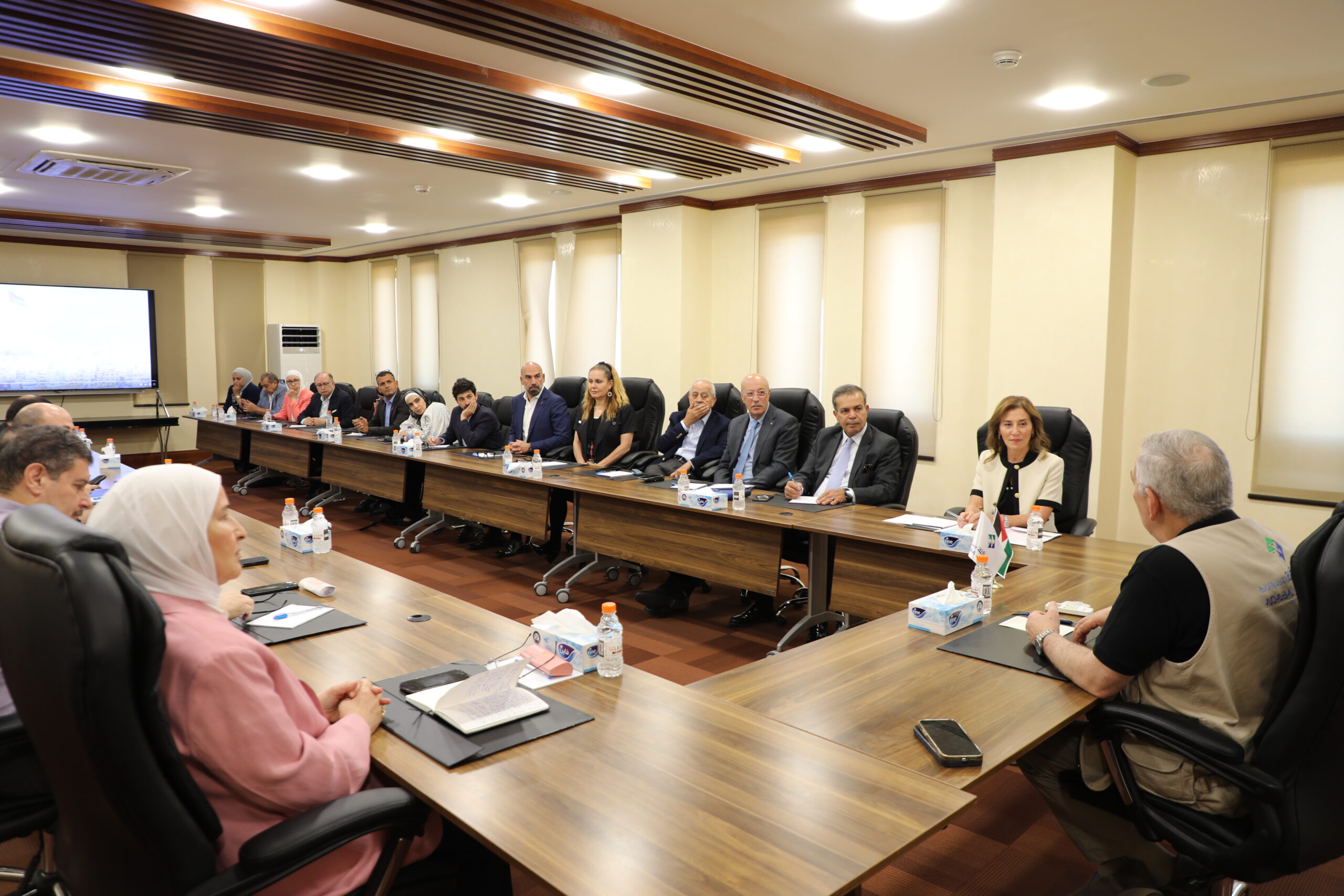
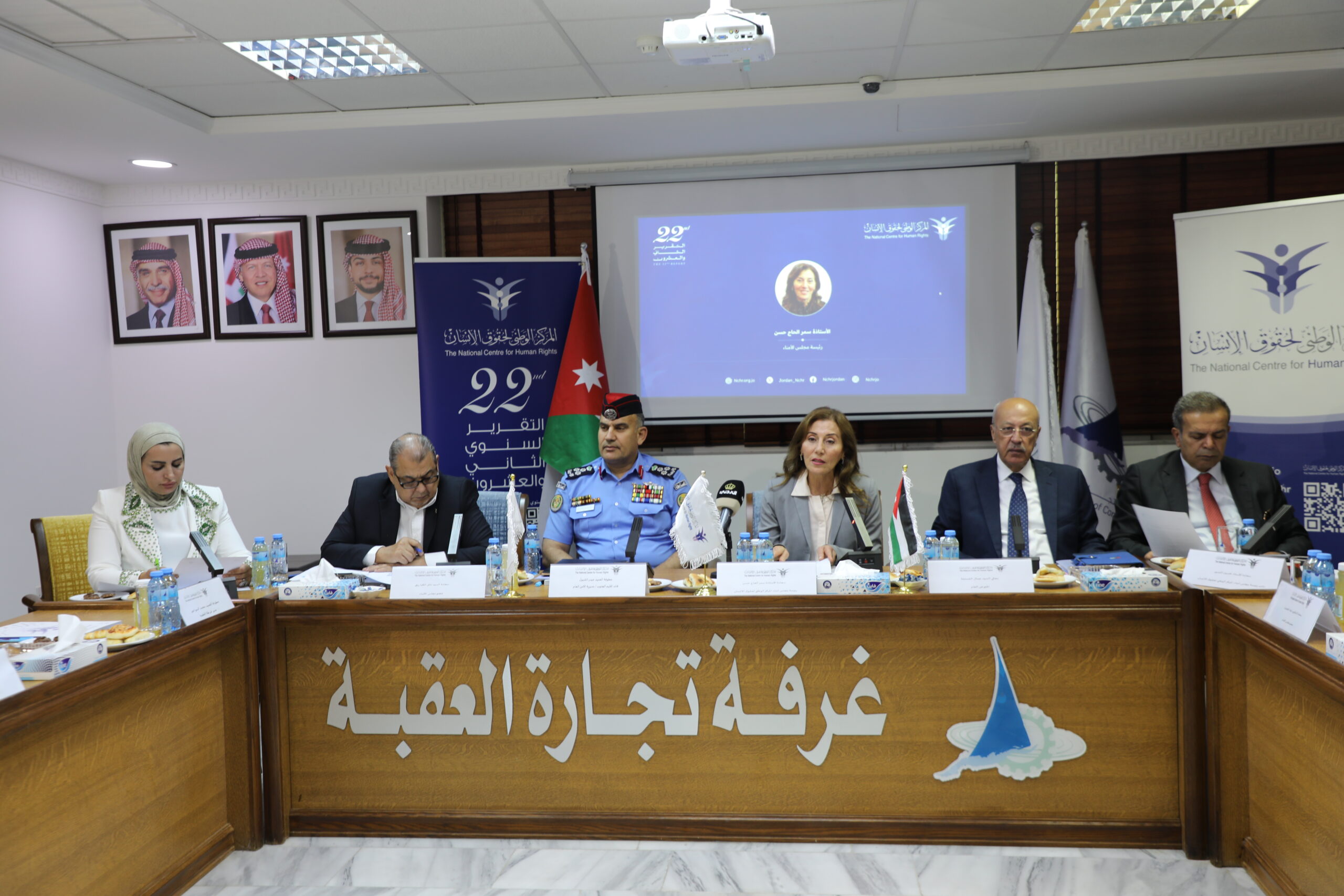
Amman – The National Center for Human Rights (NCHR) launched its 17th Annual Report on the State of Human Rights in the Kingdom for 2020 on Tuesday, during a press conference held at the Center’s headquarters by Chairman of the Board of Trustees Dr. Raheel Gharaibeh and Commissioner General for Human Rights Alaa Al-Din Al-Armouti.
During the press conference, the main findings of the report were presented. The report adopted a methodology based on monitoring policies, legislation, and practices from a human rights perspective, drawing on the Jordanian Constitution and international human rights standards, thereby serving as a national instrument for assessing the state of human rights.
The report covered three main areas: civil and political rights; economic, social, and cultural rights; and the rights of groups most in need of protection. It also included a special annex containing statistics on the complaints received by the Center during 2020, categorized according to the rights allegedly violated. In addition, the report presented both foundational and detailed recommendations.
Civil and Political Rights
Under the section on civil and political rights, the report indicated that the Center received 310 complaints during 2020.
The report documented 42 cases of ill-treatment involving inmates in correctional and rehabilitation centers. Additionally, the Center received 37 complaints from citizens alleging torture and ill-treatment by law enforcement officials in 2020, compared with 98 complaints in 2019.
Regarding administrative detention, the report noted that no amendments had been introduced during 2020 to the Crime Prevention Law No. 7 of 1954 and its amendments, despite the Center’s repeated recommendations calling for its repeal on the grounds that it fundamentally contravenes constitutional principles and standards.
The number of individuals subjected to administrative detention in 2020 reached approximately 21,322, compared with 37,853 in 2019.
The report further indicated that the actual number of inmates held in correctional and rehabilitation centers reached 17,708, while the official capacity of these facilities stood at 13,352. Consequently, overcrowding exceeded approximately 33%, negatively affecting inmates’ living conditions and their enjoyment of rights across various areas.
Regarding the right to vote and stand for election, the report noted that 2020 witnessed no amendments to the House of Representatives Election Law No. 6 of 2016 and its amendments. The Center reiterated the need to introduce the necessary amendments to this law.
Economic, Social, and Cultural Rights
Under the section on economic, social, and cultural rights, the Center reported receiving approximately 89 complaints in 2020 relating to seven principal rights: the right to development, the right to an adequate standard of living, the right to work, the right to education, the right to health, the right to a healthy environment, and cultural rights.
The report highlighted the continuous rise in poverty rates, noting that the absolute poverty rate had reached approximately 15.7%, affecting around 1.069 million Jordanian citizens.
The unemployment rate reached approximately 24.7% during the fourth quarter of 2020, indicating, according to the report, the ineffectiveness of government measures in addressing poverty and unemployment, despite the implementation of numerous national initiatives and policies supported by international assistance, particularly grants and financial aid provided by the international community.
The Center also monitored the impact of the COVID-19 pandemic on the right to an adequate standard of living, noting that the pandemic had negatively affected citizens’ enjoyment of this right and contributed to a crisis of confidence between citizens and state institutions.
This was reflected in several developments, most notably the additional financial burdens imposed on citizens as a result of rising prices for numerous goods and services, as well as increased taxes and fees.
The report also highlighted the financial difficulties experienced by a significant number of individuals and businesses in Jordan due to the repercussions of the pandemic. Many debtors became unable to meet their financial obligations to banks, financing institutions, and other creditors following the closure of numerous productive sectors as part of government measures to contain the pandemic, despite efforts to mitigate its impact on citizens.
Furthermore, exports and economic growth declined, while inflation increased alongside persistently high poverty and unemployment rates.
Domestic revenues also declined during the first eight months of 2020, recording a decrease of approximately JD 602.7 million.
The Right to Education
Regarding the right to education, the report addressed the suspension of in-person learning and the introduction of distance education as a temporary alternative in response to the COVID-19 pandemic.
In this context, the Center issued a statement on November 2, 2020, calling on the government to reassess its decision to adopt distance learning and explore alternative approaches, including blended learning, which combines online education with in-person school attendance.
The Center emphasized the need to address challenges related to ensuring that all students could effectively access and participate in distance learning.
It further stressed that, if these challenges could not be resolved, schools should be reopened under strict health and safety measures, while giving primary consideration to the best interests of students.
The Center also emphasized the necessity of addressing learning loss and establishing a clear, consistent, and well-defined system to bridge the educational gaps resulting from the suspension of in-person instruction.
Such a system should include mechanisms to assess learning loss among students across all educational stages and core subjects, as well as an analysis of educational content delivered during the distance-learning period.
The Center particularly highlighted the challenges arising from inconsistent educational policies affecting early grades, kindergarten students, and secondary school students.
It stressed the importance of ensuring that students acquire the essential knowledge and skills needed to address learning deficiencies and overcome educational shortcomings.
The Right to Health
Regarding the right to health, the report noted that healthcare resources had been largely redirected toward combating COVID-19, at the expense of other healthcare services provided to citizens.
The report also identified several challenges facing the healthcare system, including a shortage of beds in intensive care units (ICUs) and emergency departments, as well as insufficient ventilators required to treat critically ill COVID-19 patients, particularly older persons.
Additionally, the report highlighted a shortage of qualified medical teams capable of responding to pandemics of this nature, resulting in considerable pressure on healthcare workers and the exhaustion of available medical personnel.
Rights of Groups Most in Need of Protection
Under the section concerning groups most in need of protection, the report indicated that the Center received 34 complaints during 2020 relating to four main categories: women’s rights, children’s rights, the rights of persons with disabilities, and the rights of older persons.
Women’s Rights
Regarding women’s rights, the report noted that, although Jordan had ratified the Convention on the Elimination of All Forms of Discrimination against Women (CEDAW) and published it in the Official Gazette on August 1, 2007, the Kingdom continued to maintain reservations to Articles 9(2) and 16(1)(c), (d), and (g) of the Convention.
In terms of political participation, the report highlighted a decline in women’s representation in the Council of Ministers, where women held only three of the 32 ministerial positions, including the Prime Minister, representing approximately 9% of the Cabinet.
Women’s representation in the Senate also declined in 2020, with seven women serving among its 65 members.
The report further highlighted a significant development in judicial practice during 2020, when the Grand Criminal Court established a progressive judicial precedent by sentencing a young man to three years of imprisonment for committing an indecent assault against a minor girl remotely, through electronic means. The ruling was subsequently upheld by the Court of Cassation.
The Center considered this judicial precedent an important step toward expanding criminal legal protection, particularly for women, and addressing emerging forms of crime resulting from technological developments and the increasing use of electronic means to commit offenses.