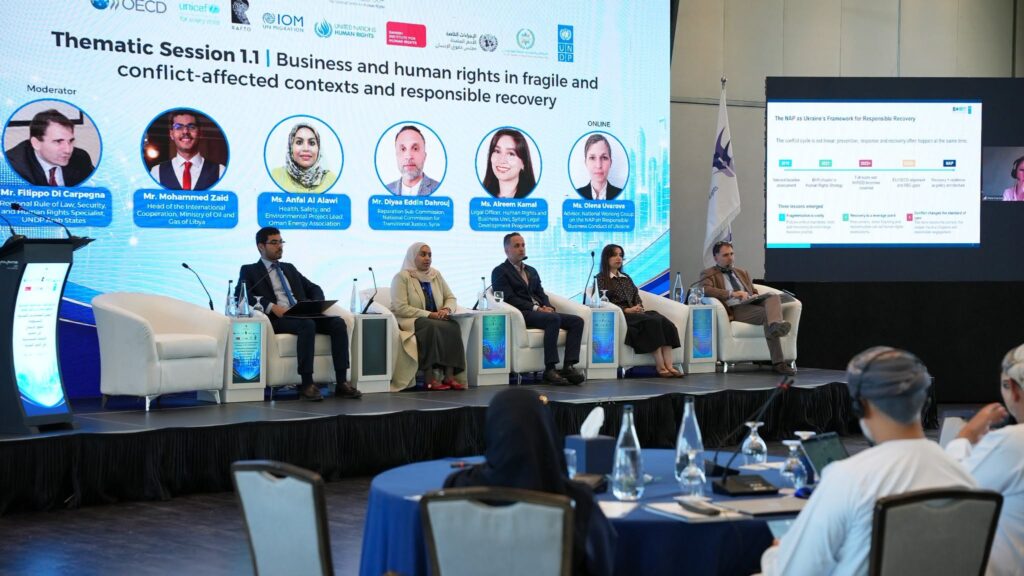
Amman** – The Third Regional Forum on Business and Human Rights in the Arab States concluded its proceedings in Amman. The Forum was hosted by the National Centre for Human Rights (NCHR) in partnership with the United Nations Development Programme (UNDP), the Office of the United Nations High Commissioner for Human Rights (OHCHR), the United Nations Children’s Fund (UNICEF), the International Organization for Migration (IOM), the Organisation for Economic Co-operation and Development (OECD), the Danish Institute for Human Rights, the Rafto Foundation, and the Arab Network of National Human Rights Institutions (ANNHRI), in cooperation with the United Nations Working Group on Business and Human Rights. The Forum brought together a broad range of participants, including representatives of governments, the private sector, workers’ organizations, civil society organizations, national human rights institutions, National Contact Points for Responsible Business Conduct, and academia.
In the closing session, H.E. Mr. Jamal Al-Shamayleh, Commissioner General for Human Rights, officially announced the conclusion of the Forum, emphasizing that this regional process serves as a multi-stakeholder platform for advancing the integration of human rights into business practices, strengthening national policies, and fostering dialogue among stakeholders amid the rapid economic and technological transformations taking place across the Arab region.
The Forum witnessed the launch of the **Amman Declaration on Advancing Responsible Business Conduct in the Arab States Region**, which constitutes the Forum’s principal outcome. The Declaration establishes a regional reference framework for enhancing the alignment of business activities with human rights and sustainable development standards, drawing upon the United Nations Guiding Principles on Business and Human Rights and other relevant international standards, including the International Labour Organization’s conventions and the OECD Guidelines for Multinational Enterprises on Responsible Business Conduct.
The Declaration reaffirms that States bear the primary obligation to protect human rights from abuses linked to business activities, while businesses have the responsibility to respect human rights throughout their operations and value chains. It further emphasizes the importance of ensuring access to effective remedy and strengthening the role of national human rights institutions, workers’ organizations, and civil society organizations in monitoring, documentation, and awareness-raising.
The Declaration also highlights the rapidly evolving global regulatory landscape for responsible business conduct, including mandatory human rights and environmental due diligence requirements, sustainability disclosure obligations, and measures to combat modern slavery, while noting the potential implications of these developments for governments and businesses across the Arab region.
Furthermore, it addresses the opportunities and challenges associated with digital transformation and artificial intelligence, calling for the development of governance and oversight frameworks that ensure the responsible use of emerging technologies and prevent adverse human rights impacts through enhanced transparency and the application of human rights due diligence.
In conflict-affected contexts, the Declaration stresses the importance of promoting responsible business conduct throughout reconstruction, recovery, and peacebuilding processes, thereby contributing to the mitigation of human rights risks and the advancement of stability and sustainable development.
The Declaration also underscores the importance of integrating human rights standards into investment and development finance decisions, including through the roles of investment promotion agencies, sovereign wealth funds, and financial institutions, while ensuring that major projects in infrastructure, energy, tourism, culture, and sports are aligned with relevant international standards.
Among its recommendations, the Declaration calls for strengthening national dialogues and National Action Plans on Business and Human Rights, enhancing effective grievance and complaint mechanisms, building the capacities of judicial and non-judicial bodies, expanding the implementation of human rights due diligence across both the public and private sectors, and empowering vulnerable groups to exercise their rights and participate meaningfully in impact assessment processes.
The Declaration further recommends strengthening the capacities of businesses, including small and medium-sized enterprises (SMEs), and enhancing partnerships among governments, the private sector, and national human rights institutions to support sustainable implementation and maximize impact.
The Forum concluded with a reaffirmation of the importance of continuing this regional process through the convening of the Fourth Regional Forum in 2027, building on the achievements of previous forums and consolidating a sustainable regional approach to advancing responsible business conduct, protecting human rights, and supporting the achievement of the Sustainable Development Goals across the Arab region.